


Springback in Sheet Metal Forming
What Is Springback in Sheet Metal Forming?
Springback is the tendency of sheet metal to partially return toward its original flat shape after a press brake removes the forming force. During bending, the material stretches on the outside radius and compresses on the inside radius. When the punch retracts, some of the elastic stress is released, causing the bend angle to open slightly.
For example, a press brake may form a part to 87°, but after the tooling releases the material, the finished angle measures 90°. This stress relaxation post-bend is known as springback.
Understanding and controlling springback is one of the most important aspects of precision sheet metal forming because even a small angular deviation can create assembly problems, misaligned holes, poor fit-up, and tolerance issues in finished products.
Why Does Springback Occur?
Every metal possesses both elastic (yield strength) and plastic properties (tensile strength).
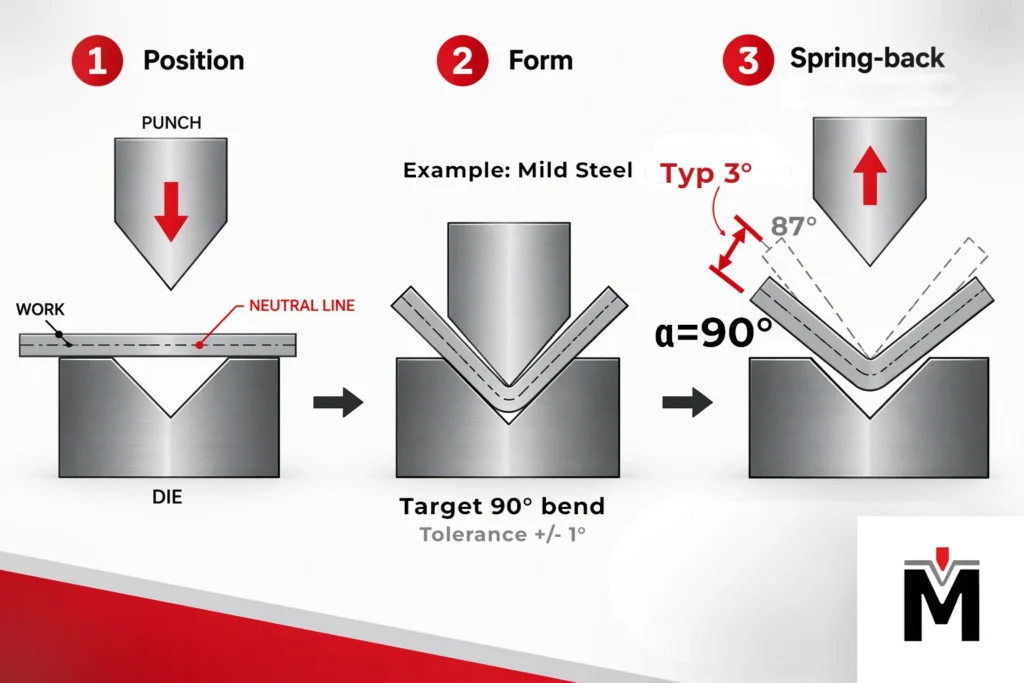
When a press brake applies force:
- Plastic deformation permanently changes the shape.
- Elastic deformation temporarily stores energy within the material.
Once the forming pressure is removed, the elastic portion attempts to recover, causing the material to “spring back.”
The amount of springback depends on several factors:
Material Type
Different alloys respond differently to forming operations. Materials with higher yield strength generally exhibit greater springback.
Typical ranking from least to most springback:
- Mild Steel
- 5052 Aluminum
- 304 Stainless Steel
- 316 Stainless Steel
- Alloy Steel such as A514, AR400F, StrenX
Material Thickness
Thicker materials generally experience less springback because a greater percentage of deformation becomes plastic rather than elastic.
For example:
- 16-gauge mild steel may exhibit noticeable springback.
- 1/4-inch mild steel typically exhibits much less springback under the same bending conditions.
Bend Radius
The larger the inside bend radius relative to material thickness, the greater the springback tendency.
A sharp air bend typically experiences less springback than a large-radius bend because more plastic deformation occurs in the bend zone. Bends formed Parallel to grain may behave differently than bends formed perpendicular to grain
How Press Brake Operators Compensate for Springback
Successful sheet metal forming requires more than simply entering a bend angle into a CNC control. Springback compensation is a routine part of precision brake operation.
Overbending
The most common correction method is over-bending. The operator intentionally bends beyond the desired angle, anticipating that the material will recover after unloading.
Example:
| Desired Angle | Recommended Formed Angle | Final Angle After Springback |
|---|---|---|
| 90° | 87° | 90° |
| 120° | 118° | 120° |
The required overbend varies with:
- Material grade
- Thickness
- Bend radius
- Tooling configuration
- Grain orientation
For this reason, experienced operators often perform first-article verification before full production begins.
How Tooling Influences Elastic Recovery post-bend
Tool selection directly affects springback behavior. Proper tooling design is critical for repeatable results.
Punch Radius Selection
A sharper punch nose concentrates force into a smaller area.
Benefits include:
- Increased plastic deformation
- Reduced springback
- Improved angle consistency
However, punch radii must remain appropriate for the material thickness and alloy to avoid cracking.
Die Opening Selection
The V-opening size significantly influences bend formation. A bottom die typically is 8-12x the material thickness. In some cases an experience press brake operator is able to use a smaller or larger V-opening to achieve the desired bend.
As a general rule:
- Larger dies require less tonnage
- Larger dies often increase springback
Selecting the correct die width balances:
- Accuracy
- Material appearance
- Tonnage requirements
- Springback control
Precision-ground tooling becomes especially important when producing tight-tolerance formed components.
Bottoming and Coining
In certain applications, manufacturers intentionally deform material beyond the normal air-bending range.
Bottom Bending – Where the material contacts the bottom of the die cavity.
Coining – where enough force is applied to compress the material at the bend line plastically. Coining is typically reserved for precision components requiring extremely tight angular tolerances.
Common Elastic Relaxation Challenges in Production
Even well-designed bend programs can experience springback-related issues.
Typical challenges include:
Long Flanges
Long flange lengths over 12″ can magnify small angular variations into significant dimensional errors. A +/-1° degree error on a short flange may be insignificant, while the same error on a long flange can create assembly problems.
Multi-Bend Parts
Each additional bend can influence the next operation by accumulating or springback challenges.
Accumulated stress relaxation after bending may affect:
- Overall dimensions
- Hole locations
- Weld fit-up
- Assembly alignment
This is one reason why complex formed components often require prototype validation before full production.
Large Radius Forming
Large bending radii over 3/4″ bends typically generate greater post-bend recoverythan sharp bends. Custom forming dies, bump bending strategies, and custom tooling may be required to achieve the final geometry.
Stainless Steel Forming
304 and 316 stainless steels are among the most common materials requiring material recovery compensation.
Compared to mild steel, stainless typically requires:
- Greater overbend
- More operator adjustment
- More extensive first-piece verification
Design Recommendations to Minimize Issues
Engineers can significantly improve manufacturability by accounting for elastic rebound during part design.
Maintain Realistic Tolerances
Not every formed angle requires ±0.5° accuracy. Typicall angular forming tolerances are +/- 1-2°
Specify tighter tolerances only where function demands them reduces manufacturing cost and improves production efficiency.
Use Standard Inside Bend Radii
Designing around common tooling radii simplifies setup and improves repeatability.
Standardized radii typically lead to more predictable springback behavior.
Prototype Critical Parts
When a design includes:
- Tight angular tolerances
- Large-radius bends
- Stainless steel
- High-strength materials
Prototype evaluation often provides the fastest path to a reliable production process.